

"Every time I claim space for myself, it's absolutely terrifying"
Trumpet player and leader Erica Binder on shy kids, leopard-print grandmothers, and performing slam poetry as climate action


To close out Women’s History Month, we sat down with Erica Binder — trumpet player, arts entrepreneur, and co-founder of the Sword Fern Collective — to talk about what it means to build a life in classical music as a young woman in 2026.
Every time Erica Binder claims space for herself, she says it’s absolutely terrifying.
“I was an extraordinarily shy kid. Networking and posting publicly make me sweat. Even doing this interview has felt like I am being chased by a bear — for real.”
It’s a confession that lands with particular weight coming from someone who’s built a career on visibility: performing, producing, creating climate-focused art events that ask audiences to sing and dance and perform slam poetry in public spaces. Someone who’s making a case, project by project, for what classical music can do when it stops preserving itself and starts evolving.
But that tension — between the terror of showing up and the commitment to doing it anyway — might be the most honest thing about building a creative life right now.
The women who made space
When Erica looks back at how she arrived in classical music, certain people feel inevitable. Her former trumpet teacher Dr. Karen Gustafson, who shared her experience on the orchestral audition circuit as a woman thirty years ago, and listened to Erica play her Haydn Trumpet Concerto cadenza “an unbelievable amount of times.” Her mentor Laura Murray, an entrepreneur and business leader in the arts who’s shared “so much of her time (and many cups of coffee).” Her late grandmother Barbara Preston, who raised Erica’s mother, led an impressive career, rocked a leopard print, and inspired her granddaughter “to be more direct and unapologetic in pursuing my goals (and occasionally, to get over myself and ‘get on with it’).”

These are the women who shaped Erica’s sense of what was possible — not just in the abstract sense of representation, but in the daily, unglamorous work of listening, mentoring, modeling what it looks like to take up space without apology.
Relief and disappointment
There’s a lot of buzz in the media right now around the unfair treatment of women in classical music, and for Erica, it brings up a mixture of relief and disappointment.
“There’s a sense of ‘how did it take us this long’ mixed with a lot of excitement for what feels like an exponential growth curve since the pandemic.”
She’s watching institutions make statements en masse — sometimes intentionally, sometimes accidentally exposing how they’ve participated in systems of sexism, racism, and classism all along. And she’s asking the question that sits underneath all of it: when we attempt to extricate these things from an institution that was truthfully built on them, does the art form still hold up?
Her answer: Yes. It will.
“What I am seeing now is that we’re moving from an industry suffering from chronic insularity to an innovative scene of creative voices and visionary entrepreneurs, who are moving beyond performative action and taking up the mantle of evolving the art form, not just preserving it.”
Excellence and agreeableness
There’s often an unspoken pressure to be both excellent and agreeable — especially as a young woman in professional spaces. Erica sees it as part of the struggle to be authentic.
“When I dove into my early career, I felt like I was armed with all of these ideas of excellence — there’s the buttoned-up professionalism of an orchestra, the J.K. Simmons/Whiplash-model work ethic of music school, the business-deal-winning firm handshake/witty icebreaker combo — and I struggled to find a balance of those things that aligned with how I wanted to be known as a human, which was kind, reasonable, and approachable.”
She was also conscious of being objectified and patronized.
Her approach to finding balance has been building confidence and strong relationships outside of her career — which has led her to build a stronger sense of self. “Having a robust community and an active life helps me distance myself from the emotional weight of disagreements at work, and helps me connect more easily with the people in my work life on a personal level without requiring validation or approval.”
The Sword Fern Collective
Just over three years ago, two Canadian youth climate activists named Paige Hunter and Victor Yin started producing events and education content focused on the complex human emotions associated with the climate crisis. At the time, Erica was working on independent music projects in Vancouver, and she felt pulled toward producing projects that used art to directly address social issues.
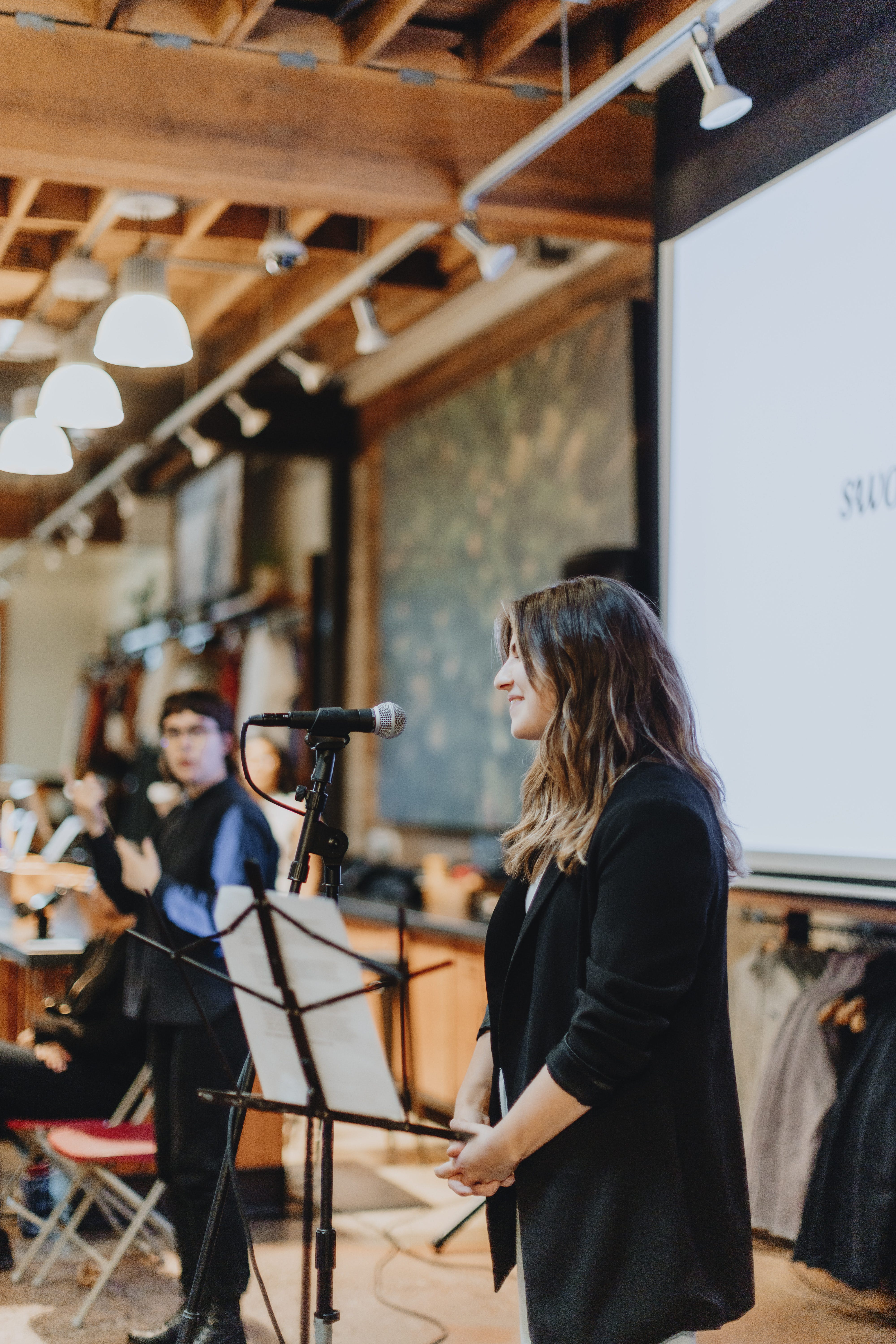
Victor and Paige both had backgrounds in art. Erica dreamed up a collaboration where they tried to use the “classical” performing arts as climate action.
They did it once — combining people’s hiking videos and nature footage into a 12-minute graphic video score, performed live in front of an audience.

People came.
They asked themselves: How far can we push audience participation? What can we do with different mediums? How do we get people to push past the obvious cringe of singing and dancing and performing slam poetry in public spaces, and lean into having an emotional experience together?
They’ve collaborated with Patagonia, OceanWise, Vancouver Opera, and a bunch of really fantastic and open-minded artists.
“It’s been the most fun thing I’ve ever done with a bunch of my friends,” Erica says.
Classical music is history
Does Erica see connections between climate action and classical music?
Yes.
“Classical music is history — it tells us so much about how people in the past interacted with power, politics, and hierarchy, and if we’re doing our job correctly as artists and arts workers today, we are currently writing the story of how we think about those things today for those who will come after us.”
She traces a line from Beethoven to John Luther Adams, Hildegard Westerkamp, and Cait Nishimura — a story that undoubtedly includes climate change.
On hope
There is a lot of anxiety around climate futures, and Erica thinks so much of that comes from the knowledge that we are not guaranteed the planet we’re currently living on in ten, five, even one year from now. In fact, we know it’s inevitable that things will change.
From her postal code in Western Canada, she sees tremendous corruption, instability, and cruelty. This moment feels urgent.
“And the idea that on top of all of that there’s another existential threat of climate change, which looms so large and yet it remains almost impossible to harness enough resources to meaningfully move the needle is more than anxiety inducing, it’s terrifying.”
So what keeps her hopeful?
The vast majority of the climate movement is held up by trust in the opinions of experts and a sense of shared accountability for the lives of the people around us.
“Working with climate activists who operate with a level of optimism that almost feels reckless has steeped me in hope — it’s a super contagious energy, and I’m grateful every day for the diverse and scrappy community that I’m surrounded with.”
Every interaction she has — on the street, with friends and family, with an artist who has created something that makes her feel seen — reminds her that to a meaningful extent we’re all in this together.
“And as long as each of us find a way to hold onto the value of human knowledge and basic connection, we are meeting the baseline for what we can contribute in the fight against life-threatening change.”

Part of the ongoing history
We asked Erica what it means to be part of Women’s History Month — to be part of this ongoing history, rather than simply looking back at it.
“Women totally rule,” she says.
She’s proud to be descended from a family of tough women — working mothers, college graduates, world travelers.
“It’s special to know that being a woman means defying expectations and continuing to reshape ideas of who women are and what we’re capable of.”
Being a part of this ongoing history means supporting queer and trans women, and putting ourselves on orchestra stages, in board rooms, and in positions of power.
It also means learning to offer herself the same grace she offers the women she looks up to.
“I try to remember that the women I look up to in my life are unapologetic about pursuing their goals, despite the feels and self-limiting beliefs that undoubtedly exist for them as well. And I would never do them the disservice of judging them for trying their best to go after what they want.”
She’s trying to learn to offer herself that same grace.
Even when it feels like being chased by a bear.
Erica Binder is a trumpet player, arts entrepreneur, and co-founder of the Sword Fern Collective based in Vancouver.